Guided Reading Activity Networks Lesson 1 Medieval Christianity
Christian-History.org does not receive any personally identifiable information from the search bar beneath.
Medieval Christianity 1:
The Early on Centre Ages
We leave the mail service-Nicene era and enter medieval Christianity with a vastly unlike Church than that which existed before Nicea.
Ad:
Calvinist traditions, some only passed on from Roman Cosmic divines, have twisted our understanding of Scripture far away from what was "ane for all delivered to the saints." Paul Pavao points out the ruptures in our current foundations and builds on "God's business firm foundation" instead in Rebuilding the Foundations, free at Smashwords and 99¢ on Kindle.
The independent churches that could boast of a unity produced only by faithful maintenance of apostolic doctrine and a mutual obedience to Christ had given fashion to a vast bureaucracy ruled by local bishops with not bad prestige and some political ability. Those bishops were answerable to even higher bishops, metropolitans over cities and iv patriarchs ruling the entire Roman empire.
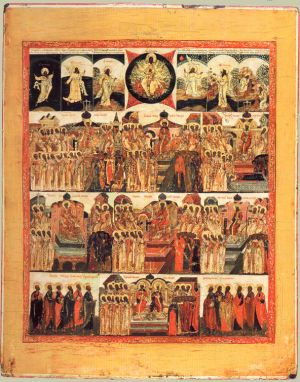 Depiction of the ecumenical councils
The unity of medieval Christianity was based on doctrines determined to exist important by councils. Those councils were called past bishops and emperors and were both local, national, and empire-broad.
The local ones ofttimes disagreed with each other, and occasionally were called purposely to disagree with one another. Information technology was the nature of the fourth dimension.
Politics and the Roman Empire
Subsequently Chalcedon, things were not then simple. In 476, the final emperor in the west was deposed past the German chieftain Odoacer. Until Charlemagne was crowned male monarch of the Franks in 800, the former western empire was ruled past a serial of Germanic kingdoms.
The eastern Roman empire would continue under the rule of Constantinople until 1453, though they suffered heavy losses to the Muslims beginning in 622.
The Muslims conquered virtually all of the Center East between 622 and 640, including the of import cities of Jerusalem and Antioch, then swept through north Africa from 642 to 695, almost eliminating Christianity from the area. In the early on 8th century, they pressed into Spain earlier existence stopped by the Franks in 732.
They as well conquered all of Persia, where they would become known as the Turks and be a thorn in the side of the eastern Roman empire until they finally overthrew Constantinople in 1453.
Thus, the political situation was a lot more complicated in early medieval Christianity than during the ante-Nicene and post-Nicene eras.
During all of medieval Christianity, people held to the faith of their leaders. As the High german tribes conquered first parts and then all of the western Roman empire, they were converted to Christianity—not to the free, wholehearted discipleship of the apostles, simply to the national religion that medieval Christianity had get. As a result, despite the conquests, Europe remained a "Christian" continent during the Center Ages.
Interestingly enough, some of the Germanic kingdoms were Arian! They disagreed with the Nicene council and held to Arius' belief that the Son was created from zip like all other creatures.
The crowning of Charlemagne by the pope in A.D. 800 would put an terminate to those sorts of deviations of the Christianity of the councils.
Who Was the Outset Pope?
Justo Gonzalez writes this about the title of pope:
The title of "pope" has undergone a long development, and therefore it is impossible to say exactly who was the get-go "pope." (The discussion "papa" was a term both of endearment and respect, and in before times was applied to any bishop who deserved particular respect, such as Cyprian in Carthage or Athanasius in Alexandria. When the bishops of Rome began receiving that title, it was still beingness used for other bishops.) (Church History: An Essential Guide, p. 43, parentheses in original)
It is clear from letters written in the fifth century and after that the bishop of Rome was gaining a primary prestige in early medieval Christianity. Even Protestant scholars are usually willing to call Gregory the Great (590-604) pope, just information technology'due south possible it could exist legitimately applied to bishops as early as Leo the Neat, who was bishop of Rome during the Council of Chalcedon.
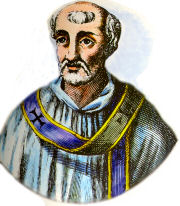 Linus, a bishop of Rome, is supposed (incorrectly) by Roman Catholics to take been the 2d pope.
The other patriarchs—those bishops given authority over whole regions at the Council of Nicea (see Post-Nicene era)—were willing to acknowledge that the Roman bishop was the primary leader of the patriarchs, just they saw him equally a first among equals, not a ruler by himself.
Later, this would directly atomic number 82 to the Great Schism, which divided the western half of the church from the eastern, leaving simply the Roman patriarch—the pope—in the west, while the other patriarchs became leaders of the modern day Orthodox Churches.
The conquering of the western empire by the Germanic tribes led directly to the isolation of the Roman bishop. He had a lot to deal with keeping medieval Christianity live and orthodox nether barbarian rule. This did non permit a lot of focus on working out doctrinal bug with eastern patriarchs, and the Roman bishop learned to piece of work solitary.
When Charlemagne proved an able plenty leader to unite much of Europe, it was a cracking relief to Rome when Pope Leo III crowned Charlemagne as emperor of the revived Holy Roman Empire. This provided some stability, gave the pope political clout, and allowed renewed interaction with the eastern patriarchs, though this interaction did non go well.
Monasticism in Medieval Christianity
The monks, having gained the respect of everyone, proved a neat boon to civilization. Whatever we Protestants may think of their religion, it is the monks who preserved Christian learning for u.s. and who tin be given much credit that we have a Bible that is as reliable as it is.
Much of the ancient civilisation disappeared, and the only institution that preserved some of information technology was the church. For that reason, even in the midst of chaos, the church became e'er stronger and more than influential, with monasticism and the papacy playing important roles in the process. (Church History: An Essential Guide, p. 43)
The most important monk of early on medieval Christianity was St. Benedict. In 529 he wrote a rule for his monastery that would go the rule for almost all monasteries of early medieval Christianity. It emphasized physical labor and involved vows of poverty, chastity, and obedience.
The Benedictine Order of monks survives to this day. Monasteries were indeed the centers of learning in the Medieval period.
Feudalism
Since Christianity had become a national religion, where citizens held to the faith of their leaders, feudalism becomes an important issue in medieval times.
Feudalism is a system where all country is owned by nobles, and the citizens worked the country for the nobles. This created many more than political leaders, which volition prove crucially important when we exit Medieval Christianity to address the Reformation.
Feudalism arose as Europe suffered turmoil under German language rulers and was squeezed in by the Muslims. Trade declined, and the only thing of lasting value was land. Those who endemic the land became the rulers of the people.
The exception to this was the cities, which did non do well in the early medieval period in Europe. Cities thrive on businesses, crafts, and money, and these are simply in enough when trade with other countries is doing well. It was non.
The driving out of the Muslims and a growing hunger for learning in the late Middle Ages would restore trade and cause cities and educations to thrive, but that is for the next section. We can finish our department on early on medieval Christian with a clarification of the Groovy Schism.
The Not bad Schism
With some semblance of political peace achieved nether Charlemagne, Rome was able to turn its optics outward.
As the meager interaction between Rome and Constantinople increased, ane particular upshot came to the forefront. The Nicene Creed, as it was approved at Constantinople in 381, had been changed in the west.
It had non been changed very much. In Latin, information technology was but one word: filioque. But what a big give-and-take that would prove to be!
Filioque ways "and the son." The Creed, as confirmed at Constantinople, said, "We believe in the Holy Spirit, who proceeds from the Begetter." Rome had added "and the Son" to the stop of that line, making the Holy Spirit to proceed from both other divine persons.
Though the patriarch of Constantinople had no doctrinal problems with the improver, he insisted that the Roman patriarch, the pope, had no authority to make changes to the official creed. As a first among equals, such a change could only be made at a council with the approval of all the other patriarchs.
The Roman patriarch, who by now saw himself equally the lonely heir to the keys of the kingdom that Christ gave to Peter, insisted that he did have such potency.
This fence flared up in the 9th century, so sabbatum on the back burner until an emissary of pope Leo Nine excommunicated the patriarch Cerularius of Constantinople in 1054. This is known as the Great Schism, and it has split catholic Christianity in half for nearly a millennium.
The churches affiliated with the patriarch of Constantinople, and even those excommunicated at Ephesus in 431 and Chalcedon in 451, are known to this day as Orthodox Churches, and those affiliated with Rome as the Roman Catholic Church building.
It is of note that Pope John Paul Ii one time said the Apostles Creed publicly without the filioque.
: I get a commission if you lot buy Xero shoes, which does not increase your toll. Barefoot running/walking is the best thing for your feet--if we did not walk on cement, asphalt, and gravel. Normal shoes compress your toes and do a lot of the work your lower leg muscles should exist doing. Xero shoes are minimalist and let your toes spread and your feet practise the work they are supposed to do. More than info at the link.

highsmithapereens.blogspot.com
Source: https://www.christian-history.org/medieval-christianity-1.html
0 Response to "Guided Reading Activity Networks Lesson 1 Medieval Christianity"
Post a Comment